Our story
We built the list we couldn't find.
This started with a member of our family: 70 years old — diabetes, stage 3 kidney disease, high blood pressure, high cholesterol. Four conditions, four contradicting diet sheets, and a Google search before every meal.
The diabetes leaflet said eat more fruit. The kidney leaflet said be careful with fruit. Neither mentioned the other. Nobody could tell us, in one place, what was actually safe to put on the plate that evening.
So we stopped looking for a better leaflet and built an engine instead. Each condition gets its own rule-set, compiled from public guidance, with nutrient data from CoFID and USDA FoodData Central. When you tick more than one condition, the engine checks every food against all of them and keeps the strictest answer — and prints the reason, so you can see why.
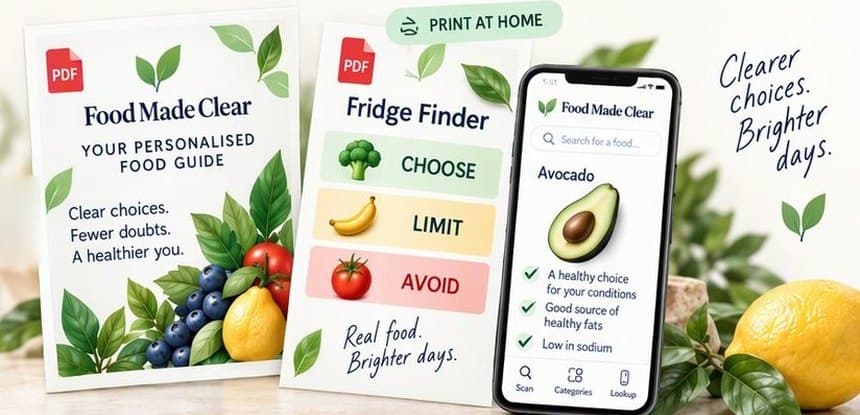
Then we printed the result in giant type and stuck it on the fridge. That fridge pack, the full guide behind it and the phone app for the supermarket are what we sell today.
Why an engine, not opinions
A person writing a list makes a judgement call on every food and can't show their working. An engine applies the same rule every time and can print its source on every line. That's why we'd rather be checked than trusted: every verdict in our guides points at the data behind it, and if your care team's advice differs from ours, theirs wins.
Managing more than one condition?